
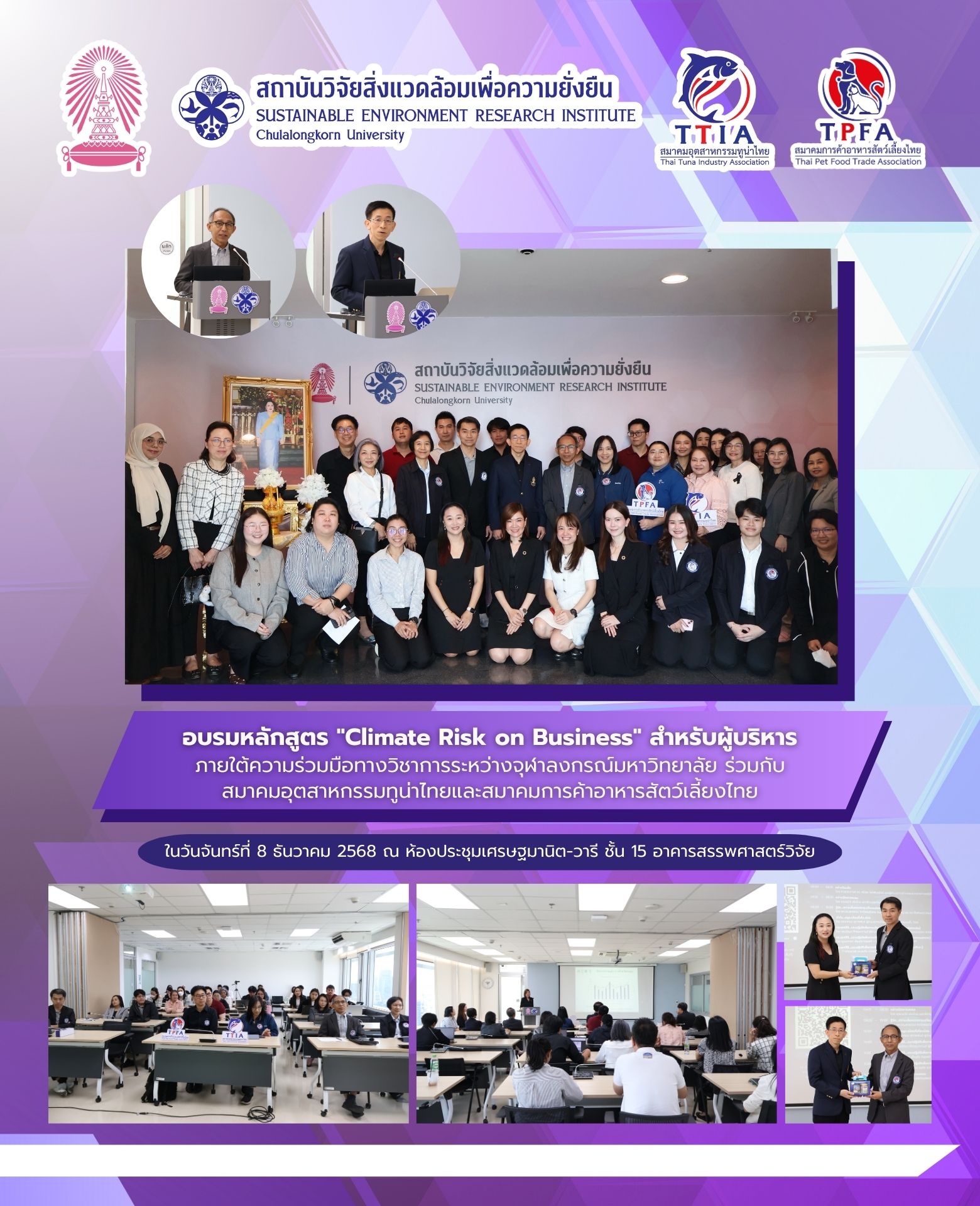
Training Program: “Climate Risk on Business” for Executives
On Monday, 8 December 2025, the Thai Tuna Industry Association (TTIA) and the Thai Pet Food Trade Association (TPFA), in collaboration with the Environmental Research Institute for Sustainability (ERiS), Chulalongkorn University, organized an executive training program entitled “Climate Risk on Business.”
The program was conducted under the Net Zero Greenhouse Gas Emissions Planning and Corporate Carbon Footprint (CFO) Development Project for the Tuna and Pet Food Industries, Phase II, and took place at the Environmental Research Institute for Sustainability, Chulalongkorn University. The training was attended by representatives from 15 member companies (20 participants)
Based on 2024 data from the tuna and pet food industries during Phase I (1 September 2024 – 30 September 2025), greenhouse gas emissions were found to be predominantly from Scope 3 (81%), followed by Scope 1 (11%) and Scope 2 (8%). This highlights that supply chain and raw material management are the most critical factors for carbon reduction in the tuna industry.
Summary of the “Climate Risk on Business” Training Program
1. Climate Risk in Thailand
Thailand faces high climate risk, having incurred economic losses exceeding THB 2.2 trillion over the past 20 years due to floods, droughts, and increasingly severe climate events driven by global warming.
The tuna industry also faces significant transition risks arising from new regulations and standards, such as IUU regulations, maritime carbon taxation, MSC certification requirements, and high-investment traceability technologies. In addition, shifting consumer preferences toward low-carbon products are accelerating the need for business adaptation.
Furthermore, the EU Packaging and Packaging Waste Regulation (PPWR) will be fully enforced from 12 August 2026, targeting waste reduction, increased recycling, and a ban on packaging with recyclability below 70% by 2030, which will significantly impact retort pouches and multi-layer packaging.
2. Keeping Pace with Climate Trends Toward TGO Certification
Thailand’s climate targets following COP30: a 47% reduction in greenhouse gas emissions by 2035, achievement of Carbon Neutrality, and acceleration toward Net Zero by 2050.
Draft Climate Change Act (under development): mandatory Emissions Trading Scheme (ETS), carbon tax and cross-border carbon measures, carbon credit systems and climate funds, and mandatory Scope 1–3 greenhouse gas reporting for juristic persons. The Act and ETS pilot are targeted for implementation in 2026, with ETS Phase 1 in 2027 and Phase 2 in 2033.
Tools and certifications by the Thailand Greenhouse Gas Management Organization (TGO): Product and Organizational Carbon Footprint, Low Carbon Label, CE-CFP, Corporate Carbon Footprint (Scope 1–3) systems with over 1,700 participating organizations, carbon offset mechanisms, Carbon Neutral and Net Zero certification, and the T-VER program supporting emission reduction and offset projects across energy, forestry, transport, and other sectors.
3. Transforming Business Towards a Low-Carbon Society – KBank
Kasikornbank (KBank) has set a Net Zero target for its operations by 2030 and a long-term Net Zero target for its financial portfolio, supported by THB 400–500 billion in sustainable finance (with over THB 173 billion achieved as of August 2025).
The bank integrates climate risk management across its organization and client portfolios, establishes carbon reduction pathways for high-emission industries, and applies green finance frameworks covering renewable energy and clean transportation. KBank also enforces ESG lending policies for fisheries and seafood processing, emphasizing transparency and zero tolerance for illegal fishing.
4. Application of Risk Management Practices – CPF
Charoen Pokphand Foods (CPF) targets Net Zero by 2050 and is the first global food company to receive SBTi certification aligned with the 1.5°C pathway. CPF focuses on reducing emissions from energy use and land use, with over 60% of emissions originating from agriculture (FLAG). Key measures include renewable energy adoption, coal phase-out, deforestation-free raw material sourcing, and supplier development programs to reduce impacts across the entire supply chain.
5. ESG Practices for Risk Management
The tuna industry plays a vital role globally but faces growing pressure from biodiversity loss, climate change, and new reporting frameworks such as SDGs, CSRD, and ESRS, which are becoming mandatory requirements for exporters.
Competitiveness in the new era requires strong ESG strategies, including carbon measurement and reduction, circular economy practices, and participation in international standards. Industry leaders such as Thai Union were highlighted as best practices, demonstrating commitment to carbon reduction, certified sustainable sourcing, and strong action against illegal fishing.